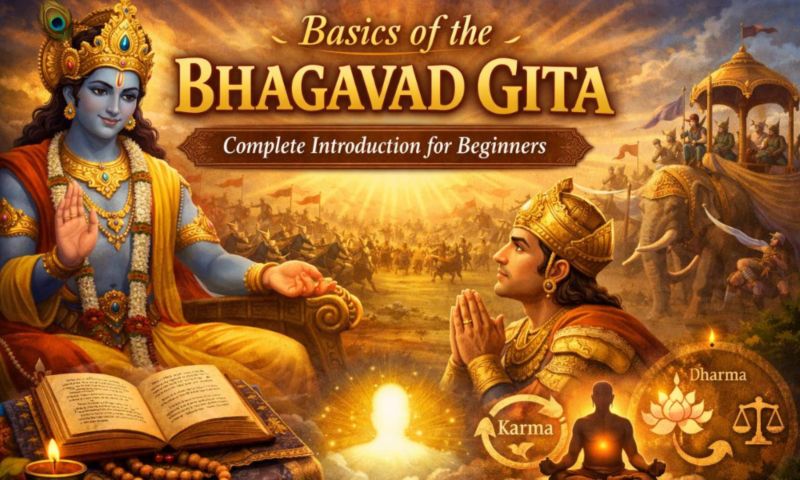
Basics of Bhagavad Gita Explained: A Complete Beginner’s Guide to Krishna’s Teachings
Introduction: Why the Bhagavad Gita Is Essential for Beginners
The Bhagavad Gita is one of the most profound and widely read spiritual texts in the world. Though rooted in ancient India, its teachings are timeless, universal, and deeply practical. For beginners, the Bhagavad Gita acts as a spiritual compass, guiding one through confusion, stress, moral dilemmas, fear, and the deeper questions of life.
Unlike religious texts that emphasize rigid rules, the Bhagavad Gita focuses on understanding, reasoning, and conscious living. It addresses the inner struggles faced by every human being—whether related to career, relationships, duty, or spiritual growth. This article explains the basics of the Bhagavad Gita in a simple, structured, and beginner-friendly way.
What Is the Bhagavad Gita?
The Bhagavad Gita, meaning “The Song of the Lord,” is a sacred dialogue between Lord Krishna and Arjuna, set on the battlefield of Kurukshetra. It consists of 700 Sanskrit verses, divided into 18 chapters, and forms part of the Mahabharata.
However, the battlefield in the Bhagavad Gita is not merely historical—it symbolizes the inner battlefield of human life, where emotions, duties, fears, and desires constantly clash.
The Context: Kurukshetra as a Symbol of Life
Arjuna, a mighty warrior, finds himself overwhelmed when he sees his relatives, teachers, and friends on the opposing side. His mind collapses under emotional conflict. He questions the purpose of victory, duty, and even life itself.
This moment represents:
- Mental breakdown during crisis
- Fear of responsibility
- Emotional attachment overpowering wisdom
Lord Krishna does not criticize Arjuna. Instead, He patiently explains the truth of existence, offering solutions that are relevant even today.
Who Is Krishna in the Bhagavad Gita?
In the Bhagavad Gita, Krishna is not just a historical personality. He represents:
- The Supreme Consciousness
- The source of all knowledge
- The inner guide (Paramatma) present in every heart
Krishna’s role is that of a teacher, friend, philosopher, and divine guide. He encourages self-realization rather than blind obedience.
Structure of the Bhagavad Gita: 18 Chapters Explained
Each chapter of the Bhagavad Gita reveals a different layer of spiritual wisdom:
- Arjuna Vishada Yoga – Despair and confusion
- Sankhya Yoga – Knowledge of the soul
- Karma Yoga – Path of selfless action
- Jnana–Karma Sanyasa Yoga – Knowledge with action
- Karma Sanyasa Yoga – Detachment from results
- Dhyana Yoga – Meditation and mind control
- Jnana–Vijnana Yoga – Knowledge of the Absolute
- Akshara Brahma Yoga – Eternal reality
- Raja Vidya Yoga – Supreme knowledge
- Vibhuti Yoga – Divine manifestations
- Vishvarupa Darshana Yoga – Universal form of God
- Bhakti Yoga – Path of devotion
- Kshetra–Kshetrajna Yoga – Matter and soul
- Gunatraya Yoga – Three modes of nature
- Purushottama Yoga – Supreme Personality
- Daivasura Sampad Yoga – Divine vs demonic qualities
- Shraddha Traya Yoga – Three types of faith
- Moksha Sanyasa Yoga – Liberation through surrender
READ ALSO:- Krishna Pastimes in Garga Samhita: Divine Lilas of Vrindavana
Core Teachings of the Bhagavad Gita for Beginners
1. The Soul Is Eternal
One of the most fundamental teachings of the Bhagavad Gita is the concept of the eternal soul (Atma). The body is temporary, but the soul is unborn and indestructible.
Understanding this truth:
- Removes fear of death
- Brings emotional stability
- Encourages spiritual awareness
2. Karma Yoga: Action Without Attachment
Krishna teaches Karma Yoga, the art of working without attachment to results.
Key principles:
- Perform your duty sincerely
- Do not obsess over success or failure
- Offer results to the Supreme
This teaching is highly relevant for:
- Professionals
- Business owners
- Students
- Homemakers
3. Dharma: Righteous Duty
Dharma means acting according to one’s responsibility and moral nature. The Bhagavad Gita emphasizes that avoiding duty due to fear or emotional weakness leads to suffering.
True Dharma includes:
- Integrity
- Responsibility
- Compassion
- Discipline
4. Bhakti Yoga: The Path of Devotion
Among all spiritual paths, Krishna glorifies Bhakti Yoga as the highest and simplest method of self-realization—especially in the present age.
Bhakti includes:
- Remembering Krishna
- Chanting His holy names
- Offering daily actions to Him
- Developing love and surrender
Krishna assures that even a small effort in devotion protects one from great fear.
5. The Three Modes of Nature (Gunas)
The Bhagavad Gita explains that all human behavior is influenced by three gunas:
- Sattva (Goodness): Knowledge, peace, purity
- Rajas (Passion): Desire, ambition, restlessness
- Tamas (Ignorance): Laziness, confusion, darkness
Spiritual growth means gradually rising above these modes through devotion and wisdom.
Meditation and Mind Control in the Gita
Krishna acknowledges that the mind is restless but teaches Dhyana Yoga as a method of control.
Beginner-friendly practices:
- Daily prayer or chanting
- Simple meditation
- Regulated lifestyle
- Mindful living
What Is Moksha According to the Bhagavad Gita?
Moksha means liberation from repeated birth and death. According to Krishna, true liberation is attained through loving surrender, not mere renunciation.
Liberation involves:
- Freedom from fear and suffering
- Eternal spiritual existence
- Loving service to the Supreme
Is the Bhagavad Gita Religious or Universal?
Although rooted in Hindu philosophy, the Bhagavad Gita is universal. It speaks to humanity at large, regardless of religion, nationality, or belief system.
Its teachings apply to:
- Personal growth
- Ethical leadership
- Emotional healing
- Spiritual fulfillment
How Beginners Should Read the Bhagavad Gita
For first-time readers:
- Start with Chapter 2 and Chapter 12
- Read slowly and reflect
- Use an authentic commentary-based edition
- Apply teachings practically
The Bhagavad Gita is not meant to be rushed—it is meant to be lived.
Common Misunderstandings About the Bhagavad Gita
❌ It promotes violence → False
✔️ It teaches inner courage and responsibility
❌ It is meant only for monks → False
✔️ It is meant for householders and professionals
❌ It rejects material life → False
✔️ It teaches balanced spiritual living
Importance of the Bhagavad Gita in the Modern Age
In today’s world of stress, anxiety, and moral confusion, the Bhagavad Gita offers:
- Mental peace
- Ethical clarity
- Emotional strength
- Spiritual direction
Its wisdom is more relevant today than ever before.
Conclusion: Why Every Beginner Should Read the Bhagavad Gita
The Bhagavad Gita is not just a religious scripture—it is a manual for conscious living. It teaches how to act wisely, love selflessly, and live purposefully.
For beginners, understanding the basics of the Bhagavad Gita opens the door to lifelong transformation. With regular study and sincere practice, Krishna’s teachings gradually illuminate every aspect of life.

 Blue Moon