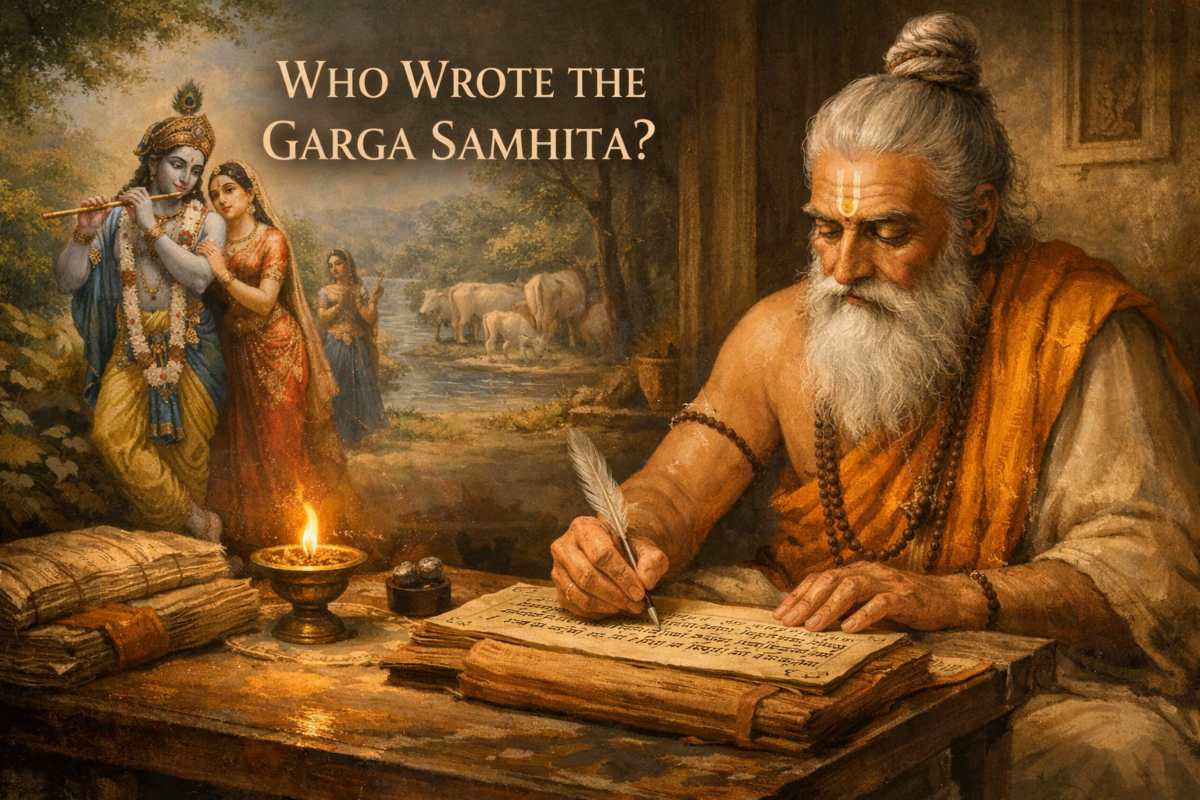
Garga Samhita The Author, History, and Spiritual Authority of This Sacred Vaishnava Text
The Garga Samhita is one of the most revered yet lesser-known scriptures within Vaishnava literature. Frequently quoted in Gaudiya Vaishnava traditions, this sacred text offers profound insight into the divine pastimes of Lord Krishna, especially His intimate leelas in Vrindavan. But a common and important question arises among readers and spiritual seekers: Who wrote the Garga Samhita?
The answer takes us deep into the heart of Vedic history, devotional theology, and the lives of great sages who preserved transcendental knowledge for humanity.
Buy Garga Samhita from ISKCON Mayapur Online Store
Who Is the Author of the Garga Samhita?
The Garga Samhita was authored by Garga Muni, one of the most respected sages of ancient India and a prominent authority on Vedic wisdom.
Garga Muni was not an ordinary scholar. He was a great rishi, astrologer, and spiritual teacher, widely known as the family priest of the Yadu dynasty, into which Lord Krishna appeared. His position gave him direct spiritual access to Krishna’s divine activities, making his writings uniquely authoritative.
The Identity and Role of Sage Garga Muni
Garga Muni occupies a significant place in Vedic history for several reasons:
- He was the royal priest of the Yadavas
- He performed naming ceremonies and astrological rites
- He was a confidential devotee of Lord Krishna
- He possessed deep realization of Krishna’s supreme position
According to Vedic tradition, Garga Muni was entrusted with spiritual responsibilities that required not only scriptural knowledge but also pure devotion and divine vision. This spiritual qualification is what makes the Garga Samhita a deeply trusted text among Vaishnavas.
When Was the Garga Samhita Written?
The Garga Samhita is traditionally dated to the Dvapara Yuga, the same era in which Lord Krishna appeared on Earth. Unlike modern historical dating, Vedic chronology is based on yuga cycles, oral transmission, and guru-parampara (disciplic succession).
Rather than being a later interpretation, the Garga Samhita is understood to be contemporary to Krishna’s earthly pastimes, recorded by a sage who directly witnessed or spiritually perceived these events.
What Is the Garga Samhita?
The Garga Samhita is a Vaishnava Purana-style scripture that focuses almost entirely on:
- The divine pastimes of Lord Krishna
- His life in Vrindavan and Mathura
- The mood of pure devotional service (bhakti)
- The supremacy of Krishna as the Supreme Personality of Godhead
Unlike many historical epics, the Garga Samhita is not written to entertain or chronicle wars, but to awaken loving devotion in the heart of the reader.
How the Garga Samhita Differs from Other Scriptures
While scriptures like the Mahabharata and Ramayana include devotion alongside history and politics, the Garga Samhita is unique because:
- It is exclusively devotional
- It emphasizes Krishna’s sweetness (madhurya)
- It reveals confidential Vrindavan pastimes
- It focuses on bhakti over karma or jnana
Because of this, Gaudiya Vaishnavas often consider the Garga Samhita a hidden jewel of Krishna literature.
Authority of the Garga Samhita in Vaishnava Tradition
The authority of the Garga Samhita comes from three main factors:
1. Authorship by Sage Garga Muni
As Krishna’s own family priest, Garga Muni was spiritually qualified to describe His divine nature.
2. Alignment with Srimad Bhagavatam
The theology of the Garga Samhita perfectly aligns with the Bhagavatam’s conclusion that Krishna is Svayam Bhagavan.
3. Acceptance by Acharyas
Gaudiya Vaishnava acharyas have quoted and respected the Garga Samhita as a reliable devotional source.
Key Themes Explained by Garga Muni
Krishna as the Supreme Personality of Godhead
Garga Muni clearly establishes Krishna not as an incarnation but as the original source of all avatars.
Vrindavan Leela
The text elaborates on Krishna’s childhood pastimes, revealing their transcendental, non-material nature.
Pure Bhakti
The Garga Samhita teaches that love and devotion, not ritual or speculation, are the highest spiritual paths.
Is Garga Samhita a Historical or Spiritual Text?
The Garga Samhita should be understood primarily as a spiritual revelation, not a modern historical record. In Vedic understanding, spiritual truth transcends linear time.
Garga Muni’s purpose was not to prove history but to reveal eternal reality—Krishna’s divine position and the soul’s relationship with Him.
Language and Transmission of the Garga Samhita
Originally composed in Sanskrit, the Garga Samhita was preserved through:
- Oral recitation
- Guru-disciple transmission
- Careful manuscript preservation
Modern English editions make this ancient wisdom accessible to global readers while maintaining scriptural integrity.
Why Garga Muni’s Words Are Considered Trustworthy
In Vedic tradition, truth is preserved through character and realization, not authorship claims alone. Garga Muni is described as:
- Detached from material gain
- Fully devoted to Krishna
- Spiritually enlightened
Such qualities ensure that his writings are free from personal bias or imagination.
Relevance of the Garga Samhita Today
Even in the modern world, the Garga Samhita remains relevant because it addresses:
- Inner emptiness
- Loss of spiritual direction
- The search for divine love
- The need for authentic devotion
Its message is timeless: the soul’s natural position is loving service to Krishna.
Why Devotees Still Read the Garga Samhita
Devotees are drawn to the Garga Samhita because it:
- Strengthens faith in Krishna
- Deepens understanding of bhakti
- Reveals confidential spiritual moods
- Complements Bhagavad Gita and Bhagavatam
Common Misconceptions About the Garga Samhita
- ❌ It is not a fictional storybook
- ❌ It is not a later medieval text
- ❌ It is not sectarian propaganda
It is a classical Vaishnava scripture rooted in Vedic authority.
Relationship Between Garga Samhita and Krishna Consciousness
The teachings of the Garga Samhita naturally support Krishna consciousness, emphasizing:
- Chanting the holy names
- Hearing Krishna’s pastimes
- Serving with devotion
- Living a spiritually centered life
Final Answer: Who Wrote the Garga Samhita?
The Garga Samhita was written by Sage Garga Muni, a great Vedic rishi, astrologer, and devoted servant of Lord Krishna. As the family priest of the Yadu dynasty, he possessed both spiritual authority and intimate knowledge of Krishna’s divine nature.
His work stands as a timeless devotional scripture, guiding seekers toward pure bhakti and eternal spiritual truth.
Conclusion
Understanding who wrote the Garga Samhita is not merely a matter of authorship—it is about recognizing spiritual authority, devotion, and realization. Through Sage Garga Muni, Krishna allowed humanity to glimpse His most intimate pastimes and deepest truths.
For readers seeking authentic Vaishnava wisdom, the Garga Samhita remains an indispensable spiritual treasure.

 Blue Moon