Who Wrote Chaitanya Bhagavata: The Divine Author Behind the Sacred Biography of Lord Chaitanya
Introduction
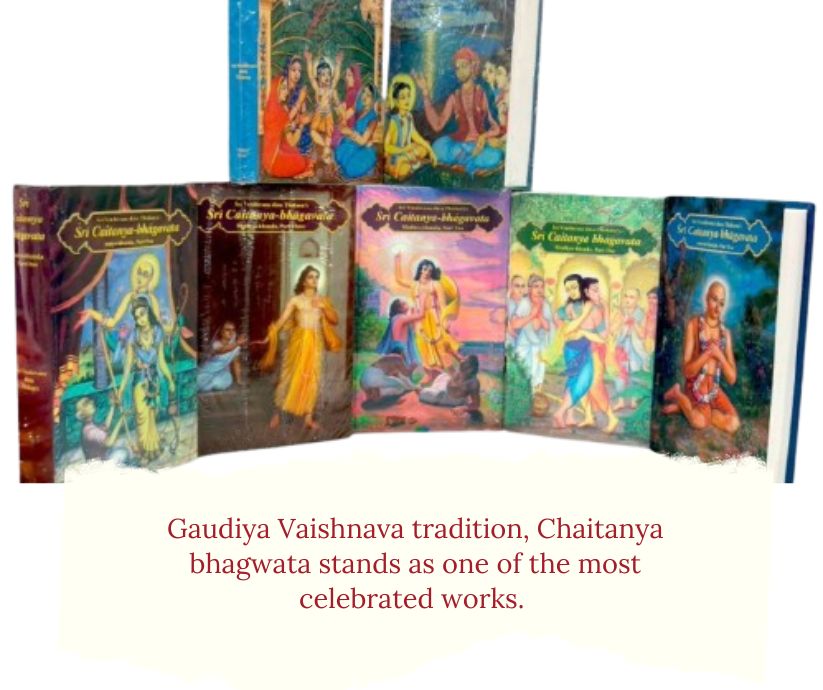
Among the sacred scriptures that illuminate the path of devotion in the Gaudiya Vaishnava Chaitanya bhagwata stands as one of the most celebrated works. It is not merely a historical account — it is a living spiritual revelation that vibrates with divine love, compassion, and transcendental wisdom. The question, “Who wrote Chaitanya Bhagavata?” leads us directly to one of the most revered personalities of Lord Chaitanya’s movement — Srila Vrindavan Das Thakur.
Experience the divine pastimes of Lord Chaitanya — Buy Chaitanya bhagwata here
Known as the Vyasa of Lord Chaitanya’s pastimes, Vrindavan Das Thakur holds a unique and exalted position among the Gaudiya Vaishnava saints. His composition, Chaitanya Bhagavata, is considered the first and most authentic biography of Lord Chaitanya Mahaprabhu — the Golden Avatar of Love who appeared in the 15th century to deliver the chanting of the holy names, Hare Krishna Hare Krishna Krishna Krishna Hare Hare, Hare Rama Hare Rama Rama Rama Hare Hare.
This article explores in depth who wrote Chaitanya Bhagavata, the purpose behind its writing, its structure and message, and its spiritual significance for devotees across generations.
The Divine Author: Srila Vrindavan Das Thakur
Vrindavan Das Thakur was a great saint, poet, and disciple of Lord Nityananda Prabhu — the eternal associate and first expansion of Lord Chaitanya Mahaprabhu. He was born around 1507 CE in Bengal to a pious mother named Narayani Devi, who herself was the niece of Srivasa Thakur — one of the main associates of Lord Chaitanya.
Narayani Devi was blessed from childhood. When she was just a young girl, Lord Chaitanya once gave her His personal remnants of prasadam and instructed her to chant the holy name. By that divine blessing, her future son, Vrindavan Das Thakur, was empowered to write the transcendental pastimes of the Lord.
Therefore, the author of Chaitanya Bhagavata is Srila Vrindavan Das Thakur, a pure devotee who received direct mercy from both Lord Chaitanya and Lord Nityananda. His work is not a product of imagination but a spiritual revelation granted by divine inspiration.
The Purpose of Writing Chaitanya Bhagavata
Vrindavan Das Thakur did not write Chaitanya Bhagavata as a mere historical record. His purpose was to glorify the Supreme Lord Chaitanya Mahaprabhu and to establish the truth that chanting the holy names of Krishna is the highest form of religion in this age of Kali.
He himself states in his work:
“The pastimes of Lord Chaitanya are unlimited; only by the mercy of Lord Nityananda have I been able to describe a small portion.”
His goal was threefold:
- To glorify Lord Chaitanya and Nityananda Prabhu.
- To inspire all souls to take shelter in the holy name of Krishna.
- To reveal the divine nature of the Lord’s associates and devotees.
In essence, the Chaitanya Bhagavata is an invitation to all living beings to awaken their dormant love for God.
Historical Context: When and Where Chaitanya Bhagavata Was Written
Vrindavan Das Thakur wrote Chaitanya Bhagavata during the early 16th century, shortly after the disappearance of Lord Chaitanya Mahaprabhu. It was composed in the Bengali language, making it accessible to the common people of Bengal and Odisha who were deeply inspired by the Sankirtana Movement of the Lord.
The writing took place in Denur village, in present-day West Bengal, under the divine guidance of Lord Nityananda. At that time, the devotees were eager to preserve the pastimes of the Lord before they faded from memory, and Vrindavan Das Thakur, being empowered by the Lord, undertook this sacred task.
READ ALSO:-Chandan Powder Benefits
The Structure of Chaitanya Bhagavata
The Chaitanya Bhagavata is divided into three main sections (Khandas):
- Adi Khanda (The Beginning Part):
It describes the appearance, childhood pastimes, and early life of Lord Chaitanya Mahaprabhu in Navadvipa. This section beautifully portrays His playful nature, His education, and the transformation from a brilliant scholar (Nimai Pandit) to a humble devotee after receiving initiation from Ishvara Puri. - Madhya Khanda (The Middle Part):
This section focuses on the Lord’s public Sankirtana pastimes, His association with devotees, and His divine interactions with Lord Nityananda. It vividly describes the spiritual ecstasy that flooded Navadvipa when Mahaprabhu began the Harinam Sankirtan movement. - Antya Khanda (The Final Part):
It narrates the later years of Lord Chaitanya, especially His travels and the ecstatic devotional mood of His associates. Though Vrindavan Das Thakur ended his narration before the Lord’s final years in Puri, his description captures the essence of divine love and devotion.
Each Khanda is written in poetic Bengali verses filled with rhythm, melody, and emotion, allowing the reader to feel the divine presence of Mahaprabhu in every word.
Why the Book Is Called “Chaitanya Bhagavata”
Initially, Vrindavan Das Thakur titled his work Chaitanya Mangala. However, later, another great devotee, Lochana Das Thakur, also composed a book by that same name. To avoid confusion, the earlier work came to be known as Chaitanya Bhagavata.
The word “Bhagavata” means “related to the Supreme Lord,” and just like Srimad Bhagavatam glorifies Lord Krishna’s pastimes, Chaitanya Bhagavata glorifies the divine acts of Lord Chaitanya, who is none other than Krishna Himself in the mood of a devotee.
Hence, the title Chaitanya Bhagavata perfectly represents the book’s divine purpose — to establish Lord Chaitanya as the Supreme Personality of Godhead and to broadcast His message of love and devotion to all.
The Spiritual Essence of Chaitanya Bhagavata
The Chaitanya Bhagavata is not only a biography; it is a scripture of realization. It contains the essence of all Vedic knowledge condensed into simple, sweet Bengali verses. Vrindavan Das Thakur reveals through his writing that:
- Chanting the holy name of Krishna is the highest spiritual practice (Nama Sankirtana).
- Lord Chaitanya Mahaprabhu is the combined incarnation of Radha and Krishna.
- The mercy of Lord Nityananda is the only means to attain spiritual perfection.
- All souls are eternal servants of Krishna, and by devotion alone can they return to their original home — the spiritual world.
The book also emphasizes humility, compassion, and equality, rejecting all forms of material pride, caste, or ritualistic exclusivity. It opened the doors of devotion to everyone — men and women, rich and poor, learned and unlearned — making bhakti truly universal.
Chaitanya Bhagavata vs. Chaitanya Charitamrita
While Chaitanya Bhagavata is the first and foundational biography of Lord Chaitanya, the Chaitanya Charitamrita by Krishnadas Kaviraj Goswami serves as its sequel and completion.
- Chaitanya Bhagavata focuses more on the early life and public preaching of Mahaprabhu.
- Chaitanya Charitamrita elaborates on His later years and deep internal moods of devotion in Jagannath Puri.
Both works are complementary and essential for understanding the complete life and teachings of Sri Chaitanya Mahaprabhu.
The Role of ISKCON and Gaudiya Vaishnavas in Preserving Chaitanya Bhagavata
The International Society for Krishna Consciousness (ISKCON), founded by His Divine Grace A.C. Bhaktivedanta Swami Srila Prabhupada, has played a major role in bringing Chaitanya Bhagavata to the global audience. Through translations, lectures, and online publications, ISKCON has preserved and spread the glories of Lord Chaitanya and His associates worldwide.
Today, devotees read Chaitanya Bhagavata as a spiritual scripture that nourishes both faith and devotion. In Mayapur, the birthplace of Lord Chaitanya, daily readings of Chaitanya Bhagavata are conducted, continuing the timeless tradition started by Vrindavan Das Thakur.
Teachings from Chaitanya Bhagavata That Transform Lives
Here are a few timeless lessons from the book:
- Chanting the Holy Name is the Essence of Religion:
By chanting Hare Krishna, one can attain liberation and divine love. - Humility and Compassion Are the Signs of True Devotion:
Lord Chaitanya taught, “Be humbler than a blade of grass, more tolerant than a tree.” - Association with Devotees Is the Key to Spiritual Progress:
Vrindavan Das Thakur emphasizes the importance of satsanga — associating with pure devotees. - Lord Nityananda’s Mercy Is the Gateway to Bhakti:
Without Nityananda’s compassion, one cannot approach Lord Chaitanya.
These teachings form the foundation of the modern-day Krishna consciousness movement.
Legacy of Srila Vrindavan Das Thakur
After completing Chaitanya Bhagavata, Vrindavan Das Thakur continued to serve the Lord and His devotees with unwavering devotion. He lived in the village of Denur, spending his days in writing, chanting, and serving the mission of Lord Nityananda.
Devotees honor him as the Vyasadeva of Lord Chaitanya’s pastimes because just as Vyasa compiled the Vedic knowledge and the Srimad Bhagavatam, Vrindavan Das Thakur revealed the transcendental activities of the Golden Lord for the benefit of humanity.
His samadhi (memorial shrine) remains a sacred pilgrimage site in West Bengal, visited by thousands of devotees every year.
Conclusion
So, who wrote Chaitanya Bhagavata? The answer shines with divine clarity:
It was written by Srila Vrindavan Das Thakur, the empowered devotee and spiritual chronicler of Lord Chaitanya’s life and teachings.
Through his poetic and heartfelt writing, he captured not just the historical events but the living essence of divine love (Prema Bhakti). His work continues to awaken countless souls to the sweetness of the holy name and the mercy of Sri Chaitanya Mahaprabhu.
Reading Chaitanya Bhagavata is not just an act of study — it is a journey into the heart of God’s love, guided by the compassionate pen of Vrindavan Das Thakur.

 Blue Moon